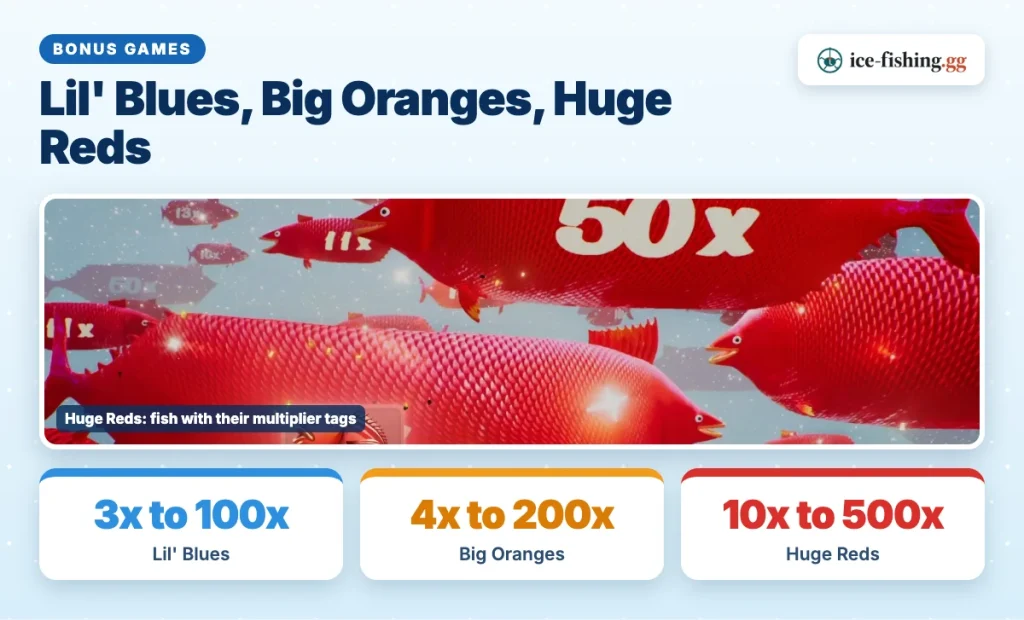
An Ice Fishing bonus game is not a side feature. It is where the big multipliers live. Three of the wheel’s segment types open one: Lil’ Blues, Big Oranges and Huge Reds, each a short fishing round on a frozen lake with its own multiplier range. You only collect from the one you backed, so a stake on the blue tile is paid nothing when the flapper settles on red.
The cut from the wheel to the lake is the moment the table wakes up. Round after round ends on a plain Leaf, and then the picture drops under the ice and the pace changes completely.
How a bonus round plays out on screen
The sequence is the same every time. Betting closes, the wheel turns, and a metal flapper at the top marks the winning segment. If that segment belongs to one of the three bonus types, the instant payouts are skipped and the round becomes a fishing round.
The scene cuts to a frozen lake. Fish swim under the ice, each carrying a multiplier tag that you can read before anything is decided: tags like 10x, 11x and 16x drift past. The host works one fish up through the hole in the ice. Nothing is settled while it is being pulled. The multiplier only becomes final once the fish is clear of the water, and then a You Win panel shows the amount in your currency.
- The flapper stops on a bonus segment. Blue, orange or red decides which of the three fishing rounds you are about to watch.
- The picture cuts to the lake. Fish appear under the ice, each with a multiplier tag on it.
- The host brings one fish up. It comes through the ice hole slowly, which is the whole point of the pause.
- The multiplier locks. It is final once the fish is out of the water, and not a second before.
- The win panel pays out. Your stake is multiplied by that number, and the table returns to the wheel.
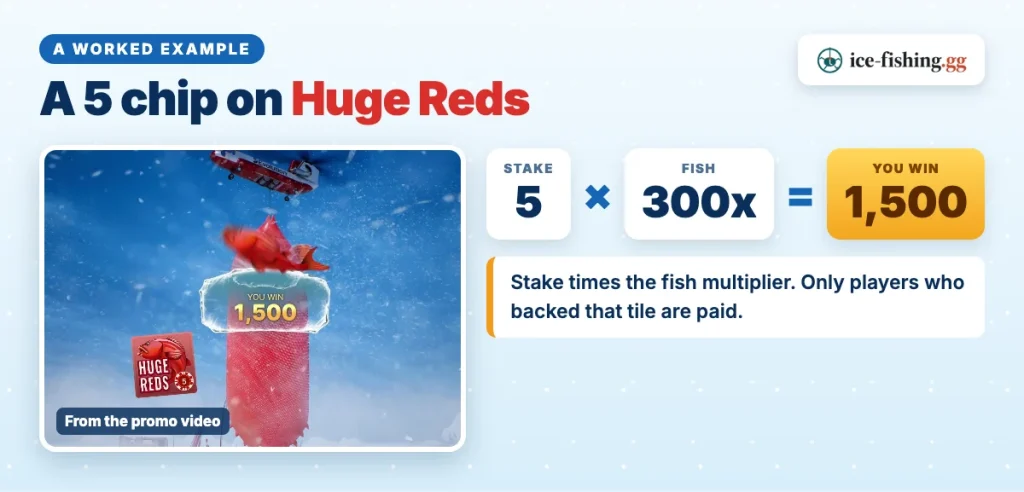
The arithmetic is as plain as it looks. A 5 chip sitting on Huge Reds, a fish that comes out at 300x, and the panel shows 1,500. Stake times multiplier, nothing else in the calculation.
Lil’ Blues
Lil’ Blues is the entry-level fishing round, running from 3x to 100x. It has the narrowest spread of the three, so the gap between a disappointing result and a good one is smaller here than on the other two tiles.
In money, a 1-unit stake returns between 3 and 100. A 10-unit stake returns between 30 and 1,000. Those are the limits of the fish themselves, before any boost from the wheel.
Because the floor sits at 3x, a blue round rarely feels like nothing happened, and it rarely feels like a jackpot either. Do not read the narrow range as a safer bet, though. A range tells you what a win pays, not how often the wheel stops on blue, and the game’s help panel at your casino is the only place that describes the return on each spot.
Big Oranges
Big Oranges sits in the middle, with fish carrying 4x to 200x. The floor is a touch higher than Lil’ Blues and the ceiling is double it, which makes the orange round the one where a modest stake can turn into a number that changes the session balance.
A 1-unit stake reaches between 4 and 200. A 10-unit stake reaches between 40 and 2,000. The fish on screen look much the same as the blue ones; the difference is in the tags they carry.
The pull through the ice is deliberately slow, and a high tag you can read under the water is still only a possibility until the fish is out.
Huge Reds
Huge Reds is the top of the three, with fish from 10x to 500x. Even the weakest result in a red round returns ten times the stake, which is why the red tile draws attention on the bet row.
A 1-unit stake reaches between 10 and 500 from the fish alone. A 10-unit stake reaches between 100 and 5,000. Then there is the second layer: before the spin, the wheel can drop a boost tag of 2x up to 10x on a bonus type, and if it lands on red, every fish multiplier in that round is raised by it. That is the route to the game’s ceiling of 5,000x the stake, and the reason a red segment with a boost tag on the tile is the most charged moment the show produces.
Davis’s note
I have watched more Huge Reds rounds than I ever had a stake on, and a big tag on a fish under the ice means nothing until it is out of the water. Watching is free at the table, which is the cheapest way to learn what the round does.
The three Ice Fishing bonus games side by side
| Bonus game | Multiplier range | 1-unit stake reaches | 10-unit stake reaches |
|---|---|---|---|
| Lil’ Blues | 3x to 100x | up to 100 | up to 1,000 |
| Big Oranges | 4x to 200x | up to 200 | up to 2,000 |
| Huge Reds | 10x to 500x | up to 500 | up to 5,000 |
Those figures are the fish only, before any boost from the wheel.
A bigger range does not make a spot better. The three tiles are priced differently by the wheel itself, and the only numbers that describe the trade at your table are in the in-game help panel, under Payouts and Rules. Open it once before you back anything; the version your casino runs is the version that pays you. If you want the second layer in detail, start with how wheel boosts stack, because a boost on a bonus type rewrites every multiplier in the round it lands on.
If you want to see a fishing round from the inside rather than from the side of the table, a single small stake on one bonus spot is enough to be in it.
All Bonuses: one ticket to every fishing round
The narrow tile at the end of the bet row covers all three bonus types at once. Back it and you are in whichever fishing round lands, blue, orange or red, with no need to guess which colour the flapper will pick.
The cost is the obvious part. All Bonuses means a stake on every bonus spot, paid on every spin, including the many spins that finish on a plain Leaf and pay the bonus tiles nothing. You are buying coverage, not a discount, and the house edge printed in the help panel applies to that tile like any other.
It suits a player whose interest is the fishing round itself rather than picking between the three, and it sits alongside the two Leaf spots rather than replacing them, since you can back several spots in the same round. The layout of the bet row makes the structure clear once you have seen a few spins go by.
Is there an Ice Fishing bonus time?
No. There is no bonus hour, no warm-up period and no point in a session when the wheel becomes more generous. Each spin is settled on its own and carries nothing forward, so twenty plain Leaf results in a row change the next spin exactly as much as one does, which is not at all.
Long gaps between fishing rounds are normal, and so are two in quick succession. Both are what a random wheel looks like from a chair. The people selling a bonus time, a signal feed or a robot that calls the next segment are selling a pattern that does not exist in the maths, and they are charging for it. The show from the start, including where the real figures sit, is the place to begin.
FAQ
What are the bonus games in Ice Fishing?
There are three: Lil’ Blues, Big Oranges and Huge Reds. Each one is a short fishing round on a frozen lake where fish carry multiplier tags, and each has its own range. Lil’ Blues runs from 3x to 100x, Big Oranges from 4x to 200x and Huge Reds from 10x to 500x.
What is the highest multiplier in Huge Reds?
The fish in a Huge Reds round carry up to 500x. If the wheel put a boost on the red segments before the spin, every fish multiplier in that round is raised by it, and the game’s ceiling is 5,000x the stake.
Can I win a bonus game I did not bet on?
No. Everyone at the table can watch the round and see the fish come up, but only players with a stake on that bonus spot are paid. A stake on Lil’ Blues pays nothing when the wheel lands on Big Oranges.
What does All Bonuses cover?
It places a stake across every bonus segment, so whichever of the three fishing rounds lands, you are in it. The trade is cost: you pay for all three spots on every spin, including the many spins that end on a plain Leaf.
Do bonus rounds come at certain times?
No. Each spin is settled on its own and the wheel keeps no record of what came before, so no hour, no streak and no table pattern makes a bonus segment more likely. Long gaps between fishing rounds are a normal feature of a random wheel.