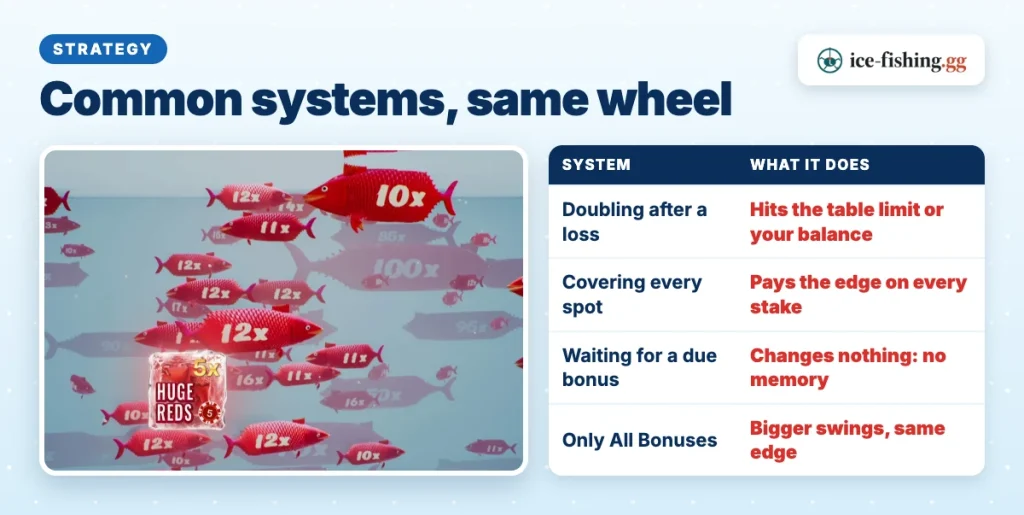
I have tried the popular ideas on Ice Fishing at small stakes: doubling after a loss, covering every spot, and sitting out rounds while waiting for a bonus game that felt due. None of them changed a single spin. An Ice Fishing strategy cannot move the wheel, because every round is independent of the one before it and the multipliers are dropped in at random after betting closes.
What a plan can do is control the money side. How much you put at risk, how long a session lasts, and whether anything is left when you close the tab. That part is yours, so that is what this page is about.
Why no Ice Fishing strategy beats the wheel
Three things stand between any system and a profit, and none of them care about your betting pattern.
The first is independence. The wheel has 53 segments and no memory, so a result cannot be influenced by what came before it. A plain Leaf landing five times in a row tells you nothing about the sixth round, in the same way that a bonus game landing twice in a row tells you nothing either.
The second is the house edge. Every bet spot on the table, from Leaf 1 to All Bonuses, is priced so that the game keeps a small share of every stake over time. The exact figures for your table sit in the in-game help panel, under tabs such as Payouts and Rules, and they are the only ones that apply to you. Spreading stakes across more spots does not dilute that share. It applies it to more money.
The third is timing. The random multipliers land after betting closes, so you are never choosing a boosted spot. You are choosing a spot and then finding out whether a boost arrived. If you are still new to the table layout, how the game works is the place to start before any of this matters.
Popular systems and what they do to your money
Forum threads swap the same four ideas endlessly, and the Reddit version reads much like the Telegram version. Each of them does something measurable to your bankroll. None of them does anything to the wheel.
Doubling after a loss (martingale)
The idea is that one win recovers everything, so you double your stake after each losing round. The arithmetic grows faster than it looks on paper: a run of eight or nine losses turns a small opening stake into a large one. Two walls stop it. The table has a maximum bet, and your balance has a floor. Hit either wall during a normal losing run and you are sitting on your biggest stake of the night with exactly the same chance as your first, smallest one.
Covering every spot
Backing Leaf 1, Leaf 2 and all three bonus tiles guarantees that something lands. It does not guarantee a profit, because you paid for every losing spot on the same spin. You are now paying the edge five or six times per round instead of once, and a modest Leaf result often returns less than the total you staked. Certainty of a result is not the same as certainty of a return.
Waiting for a bonus that is due
This is the one I hear most. Count the rounds since the last bonus game, then push hard when the drought looks long. Long stretches of plain Leaf results are normal, and they are not a loading bar.
The claim
Wait ten rounds without a bonus, then bet big.
What I found
The wheel does not know there were ten rounds. The next spin has the same chances as the first, and the only thing the waiting changed was the size of the stake I was willing to risk on it.
Only betting All Bonuses
All Bonuses buys a ticket to whichever bonus game lands, whether that is Lil’ Blues, Big Oranges or Huge Reds. The appeal is obvious, since those rounds carry the fish multipliers and the path to the 5,000x ceiling. The cost is that you stake on every bonus segment every round, and plain Leaf results give you nothing back. Bigger swings in both directions, same edge underneath.
Is there a best time to play Ice Fishing?
No, and nothing about the schedule changes that. The time of day, the day of the week, the host in the corner of the screen, the number of players at the table and how long you have been watching all sit outside the result. The wheel is a virtual wheel, so there is no physical wear, no dealer habit and no quiet hour when the odds soften.
That is also why the best-time question is such useful bait. A seller who tells you to play between certain hours is making a claim that costs nothing to make and cannot be measured, which is the same trick the signal sellers use with their round-by-round calls. If a tip comes with a time window and a payment link, the window is decoration.
What I learned from playing the wheel
Most of my rounds ended on a plain Leaf. That is the texture of the game: quick spins, small instant results, and then a wait. The host sat in the corner box through most of it, waiting for a bonus round that took its time.
The part nobody warns you about is watching a bonus game you did not bet on. Everyone at the table sees the lake scene, the fish with their multiplier tags, and the number that pops when one comes up through the ice. Only the players who backed that tile get paid. Sitting through one of those with no stake on it is the single strongest push toward raising your next bet, and that push has no connection to what the next spin will do.
Davis’s note
The round I regretted skipping never changed what the round after it would do.
No pattern I tried altered the pace, the results or the dry runs. The one thing that shifted my experience was understanding how bonus rounds pay before I staked anything on them, so a long gap felt like the game working normally rather than something going wrong.
Ice Fishing tips and tricks that help
These do not improve your chances. They protect your money and your attention, which is the only ground where you have an advantage.
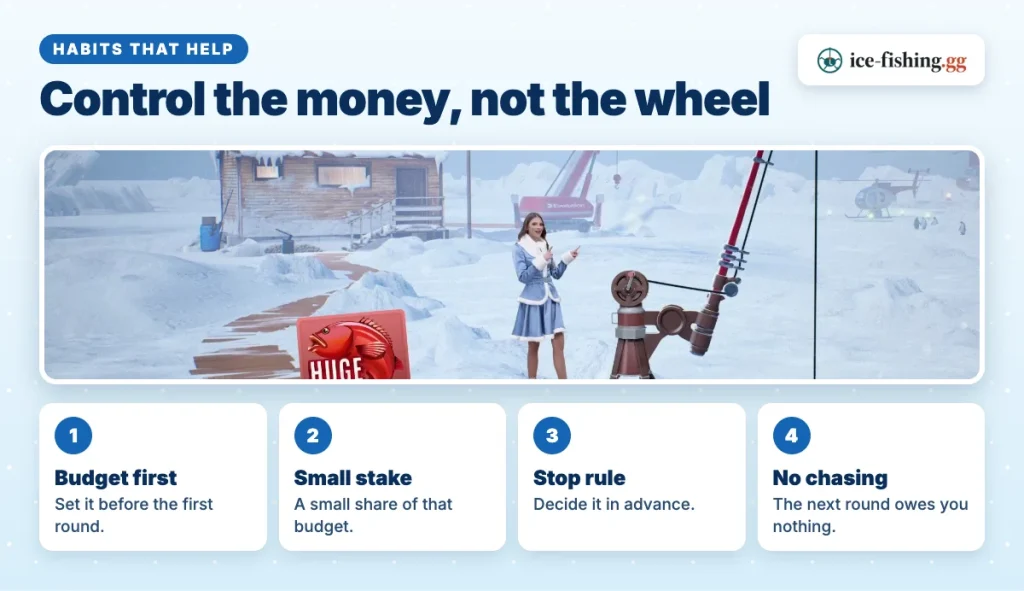
- Set a session budget before you open the table, and treat it as spent money rather than an investment.
- Pick a stake that is a small share of that budget, so a long run without a bonus game does not end the session.
- Decide your stopping point in advance, for both a loss and a win, and write it down if that helps.
- Watch a few rounds first. Once you are logged in you can sit at the table without betting and see the pace for free.
- Open the help panel and read the Payouts and Rules tabs for your casino, since versions can differ between lobbies.
- Never chase a loss by raising the stake. The next round does not owe you the last one.
- Never pay anyone for signals, predictions, a robot or a VIP group. There is nothing to sell.
My own routine is unglamorous. I decide the budget before I log in, I keep the stake small enough that a quiet stretch is boring rather than painful, and when the budget is gone the session is over for the day.
The game runs inside licensed casino lobbies, in a browser or a casino’s own app. Set your budget before you open one, not after the first dry run.
FAQ
Is there a winning strategy for Ice Fishing?
No. The wheel result is random in every round and each bet spot carries a house edge, which you can see in the help panel at your casino. A betting pattern changes the size and timing of your wins and losses, never the chances behind them. What a plan can do is cap how much you risk and decide when you stop.
What is the best time to play Ice Fishing?
There is no good or bad time. The hour, the day, the host on screen and the number of players at the table have no effect on which segment the flapper lands on. Anyone selling a best time, a hot window or a prediction for today is selling you a coin flip with a fee attached.
Does the martingale system work on the leaf bets?
Doubling after every loss needs a bankroll that keeps doubling too, and the table has an upper bet limit. A run of losing rounds will reach one of those two walls, and when it does you are holding your biggest stake of the session with the same chance as your first one. The expected loss per round does not move.
Should I bet on All Bonuses every round?
All Bonuses gives you a stake on every bonus segment, so you join whichever bonus game lands. You pay for that cover on every spin, and plain Leaf segments still end the round with nothing for you. It makes the swings bigger in both directions without lowering the edge.
How much should I bet per round?
Decide a session budget first, then pick a stake small enough that the budget covers a long run of rounds without a bonus game. A stake that only survives a handful of spins turns a normal dry stretch into a finished session. Never raise the stake to win back what the previous rounds took.